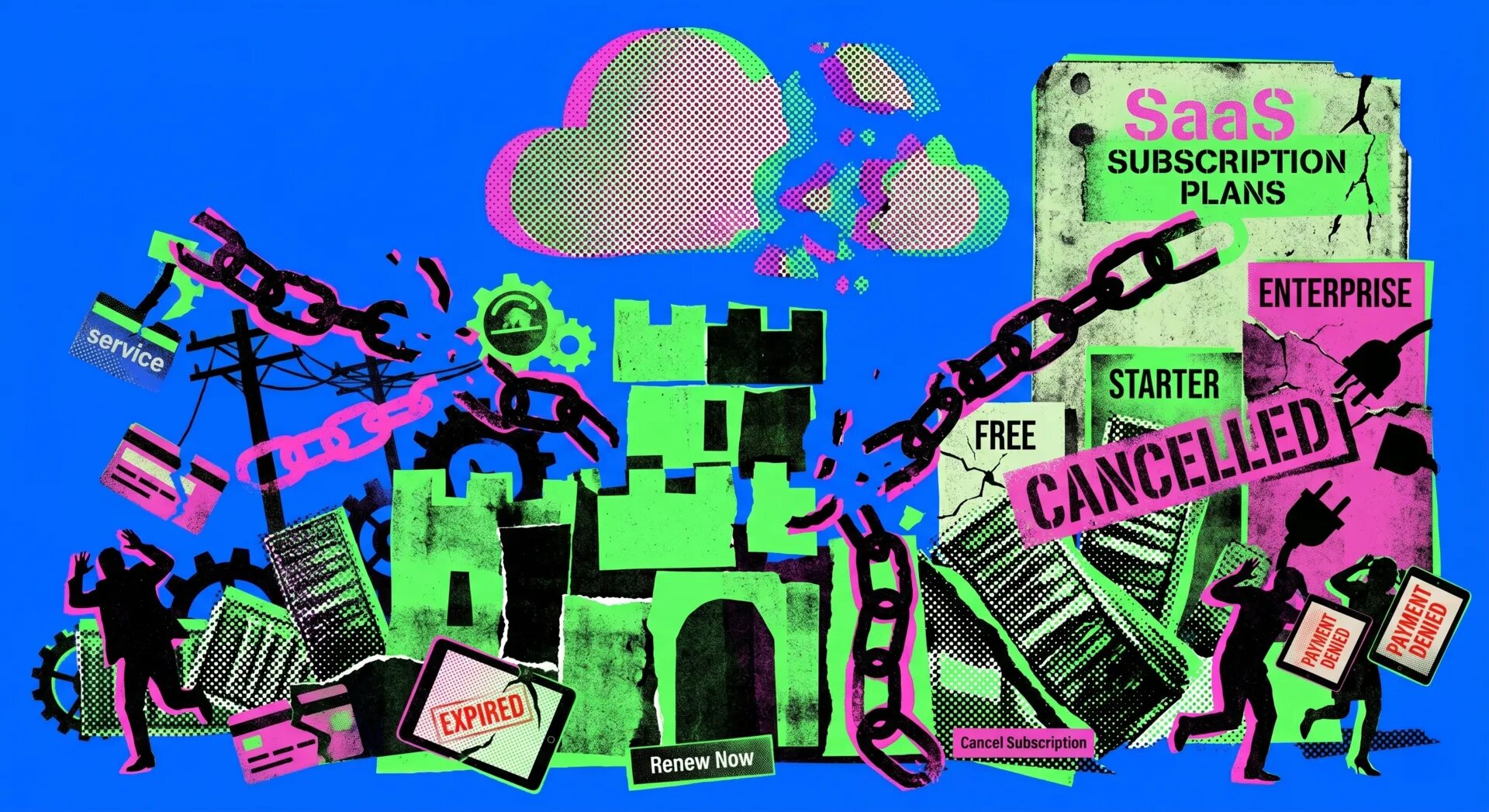
$2T of SaaS (software as a service company) value vaporized — and that was Class A rent money.
Picture a Class A office tower in SoMa (San Francisco).
280,000 square feet.
Fully leased through 2027 to a mid-cap SaaS company everyone's heard of.
The landlord is feeling pretty good. Rent is paid. Tenant is "healthy." The 2024 re-leasing wave was a miracle and he caught it.
What he doesn't know is that his tenant's stock is down 71% since October. The board just greenlit a 30% reduction in force. And the CFO has already quietly asked the real estate team what it costs to sublease three full floors.
That landlord is you. Or he's your neighbor. Or he's the guy in your LP pool who's been emailing you about "a great Class A opportunity in a gateway market."
Figma down ~87% from its 2025 peak.
Duolingo down ~80% from its 2025 peak.
Monday.com down ~79% from its 2025 peak.
Microsoft shed roughly $357 billion in a single day (Jan 30, 2026 — the second-largest single-day market-cap loss on record).
The IGV is down ~25% off its October peak (and was off 37% at the trough).
For the first time in modern history, software is trading at a discount to the S&P 500.
Every one of those companies is a tenant. Or was. And nobody in commercial real estate is pricing this in yet.
Meanwhile, Blackstone is sitting on $65 billion+ in real estate dry powder (firm-wide dry powder is $198B as of the Q4 2025 earnings report), Apollo is weaponizing its insurance arm to out-lever the banks, and Oaktree's John Brady called this "one of the most significant real estate distressed investment cycles of the last 40 years."
The smart money sees what is coming. The mid-market is still pitching 2021 cap rates. The next 180 days are not a recovery. They are a sorting.
Let's crack the ball open.
TL;DR: $2T Vaporized, $2T+ Maturing, One Brutal Sorting
Roughly $2 trillion in public SaaS value is gone. Roughly $875 billion of commercial/multifamily mortgage debt is maturing in 2026 per the MBA (with cumulative 2025–2026 maturities approaching ~$1.8 trillion on Trepp's broader cut). The Fed is parked at 3.50–3.75% with no rescue cuts coming. Top-tier GPs are sitting on a record warchest. Tier 2 and Tier 3 sponsors are starving. Office in tech-heavy submarkets is about to get a second leg down as agentic AI eats per-seat SaaS pricing and tenants shed seats they already lease. The 90- to 180-day window in front of us is the cleanest entry point most investors will see in their careers — and the most unforgiving exit for anyone on the wrong side of the basis reset.
Think you know the real numbers behind these deals?
10 questions · ~5 min
The Setup: Where We Actually Are Right Now
The Fed is sitting at 3.5 to 3.75%. Powell has made it crystal clear he is in no rush. J.P. Morgan Global Research is now calling for the Fed to hold steady through the rest of 2026, with the next move potentially being a hike in Q3 2027. Let that sink in. The market spent two years praying for cuts, got a couple of scraps in late 2025, and the next realistic move on the table might actually be up.

Meanwhile, the 2026 CRE maturity wall is real and it is chunky. The MBA's Feb 2026 survey pegs 2026 commercial/multifamily mortgage maturities at ~$875 billion (about 17% of the ~$5T outstanding stack, technically down from $957B in 2025), while Trepp puts cumulative 2025–2026 maturities at roughly $1.8 trillion, and IPA's narrower cut sits closer to $539 billion. Pick your methodology, but multifamily alone jumps 56% from $104.1 billion in 2025 to $162.1 billion in 2026 — that part isn't ambiguous. The "extend and pretend" window that saved everyone's bacon in 2024 and 2025 is officially closing. Lenders are out of patience, patience is out of lenders, and the three-year loans from 2022 with two one-year extensions have finally run out of extensions.
IGV Software ETF — Indexed Trajectory (Oct 2025 = 100)
The iShares Expanded Tech-Software ETF (IGV) was off ~37% at the trough and is currently ~25% off its October 2025 peak — a six-month one-way trip with a recent partial bounce. Marquee constituents are deeper underwater from their 2025 peaks: Figma ~-87%, Duolingo ~-80%, Monday.com ~-79%. For the first time in modern history, software is trading at a discount to the S&P 500. Every one of these companies signed Class A office leases in 2021–2022.
Layer the SaaS drawdown on top of that and you have a tenant story that nobody is underwriting. Figma, Duolingo, Monday.com, Asana — these are the same names that signed Class A office leases in San Francisco, Austin, Seattle, and Bay Area suburbs in 2021 and 2022 when WeWork-adjacent fit-outs and free rent were a status symbol. They are not signing renewals at those terms. Many will not be signing renewals at all.
That is the stage. Now the show.
The Great Sorting: Welcome to the Reckoning
Here is the fun part nobody in your LinkedIn feed wants to say out loud: the second half of 2026 is going to look like a slow-motion foreclosure auction wearing a suit.
Not a crash. A sorting. A reckoning for the owners who spent 2024 and 2025 telling their LPs that "rates are coming down soon, we just need another year." The lenders who were handing out extensions like Halloween candy are done. Kidder Mathews' own people are already saying the quiet part loud: lenders cannot defer decisions forever. The math just does not work anymore on a $40M loan at 3.25% that now needs to refi at 6.5% with 55% LTV instead of 75%.
2026 CRE Debt Maturities by Property Type ($ Billions)
Multifamily leads the 2026 maturity wall at ~$162B, up roughly 56% year-over-year from $104B in 2025. Office is right behind at ~$138B with the worst refinance economics in the stack. The 'extend and pretend' window that saved everyone's bacon in 2024 and 2025 is closing. Three-year loans from 2022 with two one-year extensions are out of extensions.
| Sector | 2026 Maturities | Avg Cap Rate | Vacancy Trend | Capital Available | Sponsor Risk Outlook |
|---|---|---|---|---|---|
| Multifamily | $162B (+56% YoY) | 5.10% | Peaking, beginning to compress | Heavy — agency + private credit | Bifurcating: trophy wins, Sun Belt syndicators bleed |
| Office | $138B | 8.4% (Class A primary) | Stabilizing trophy / second leg down secondary | Limited — selective for trophy only | SaaSpocalypse risk in tech submarkets — high |
| Industrial | $67B | 5.6% | Reaccelerating after 2024 softening | Strong — institutional preferred sector | Low — supply absorption normalized |
| Retail (Grocery-Anchored) | $84B (all retail) | 6.4% | Tightening — sub-5% vacancy in core SBSA | Strong — pension capital rotating in | Low — necessity-based moat |
| Hotel | $52B | 8.2% | RevPAR recovering, business travel mixed | Selective — branded only | Moderate — election + tariff sensitivity |
| Self-Storage / IOS / MHC | Included in 'Other' $36B | 6.0–6.8% | Stable to tightening | Quiet flood — LPs rotating in | Low — boring is the new alpha |
What happens in the next 90 to 180 days:
- More "distressed sellers," not "distressed properties." This is the key distinction most doom-scrollers miss. The assets are largely fine. Occupancy is fine. NOI is trending. The capital stack is what is broken. This is 2010 with better fundamentals, which is arguably more dangerous for the seller and more lucrative for the buyer.
- Office stops being a dirty word. I know. I said it. But MSCI Real Capital Analytics is reporting office trades were up 24% through September 2025 at discounts to replacement cost, and CBRE's people are telling anyone who will listen that institutional capital is getting comfortable again. Trophy Class A is already scarce. Secondary office is getting picked over by vulture funds that finally decided the basis reset is real.
- Cap rates stop moving. Then they start moving the wrong way for sellers of mediocre assets. CoStar is seeing multifamily and industrial vacancies peak and rent growth reaccelerate. Good assets will see cap rate compression of 5–15 bps. Bad assets in bad submarkets will see cap rates expand because buyers will finally have the leverage to price in the risk they have been eating for three years.
- Data center pushback becomes real. Colliers is already flagging that community opposition is shelving projects. If you are underwriting to a 2024-vintage data center thesis, good luck. Power, water, and zoning are the new cap rate expansion.
The Polarizing Take Nobody Is Publishing
Here is where I lose half my subscribers. Ready?
"Private equity is now a mature industry. The conditions that created outsized returns — declining rates, multiple expansion, cheap leverage — are gone. Alpha is going to be made, not found."
— McKinsey & Company, Global Private Markets Report 2026
The mid-market sponsor is cooked.
Not the institutional shop with a $2B fund. Not the genuine entrepreneur with deep operational chops and a local edge. The squishy middle. The $50M-to-$200M AUM sponsor who spent the last decade acquiring B-minus assets in C-plus markets using bridge debt and telling their investors they were "opportunistic." That playbook is a smoldering pile.
McKinsey's 2026 Global Private Markets Report put it cleanly: private equity is now a mature industry. The conditions that created outsized returns — declining rates, multiple expansion, cheap leverage — are gone. Alpha is going to be made, not found.
Translation: you have to actually be good now.
Compare this to where the capital is actually going. Blackstone is sitting on $65 billion in real estate dry powder. RW Capital just said there is $15B+ for real estate private credit alone in 2026. PERE reported global fundraising hit $164.4 billion in the first three quarters of 2025 with $115 billion of it targeting North America. That is not a shortage of capital. That is a flood.
But here is the kicker: nearly all of it is flying first class to the top-tier GPs. S&P Global is reporting LPs are in the middle of what they are calling a "flight to quality." Blackstone, Apollo, Brookfield, Ares: feast. Tier 2 and Tier 3 sponsors: famine. It is the most violent barbell the CRE capital stack has ever produced.
Raising Capital in This Market: Two Very Different Games
If you are raising right now, the environment is either the easiest or the hardest it has been in 15 years, and the dividing line is not what you think.
It is getting easier for:
- Sponsors with a real, defensible track record. Not "we did good on 4 deals in 2021." Real. Through a cycle. With DPI, not just TVPI.
- Operators in boring sectors. Self-storage, grocery-anchored retail, medical office, industrial outdoor storage, manufactured housing. The boring stuff is where the pension money is quietly flowing. Heitman confirmed LPs are shifting back to core-plus.
- Anyone with a private credit angle. Real estate debt strategies have become the belle of the ball. If you can originate, you can raise.
- Family office–native sponsors. HNWIs are sitting on cash, terrified of the S&P at all-time highs, and looking for alternatives. Reg D 506(c) capital is flowing to sponsors who communicate clearly and report like adults.
It is getting brutally harder for:
- Sun Belt multifamily syndicators. Oversupply has compressed margins through at least late 2027. If your thesis is "Phoenix and Dallas will keep ripping," your LPs heard that already and got burned.
- Office-only opportunistic funds. The basis reset is real, but so is the lender selectivity. Equity is available for trophy. Equity for secondary office is a myth.
- Anyone underwriting sub-6% cap rates on value-add. Nobody believes you anymore.
- Sponsors who went dark in 2023 and 2024. If you stopped communicating with your LPs during the hard years, do not bother calling. They remember.
Capital in 2026 is a trust business, not a deal business. The deal memo does not close the round. The relationship does. The LPs who locked up their money in 2021 and are now on their 9th email about a "short-term extension" have long memories. The market is about to bifurcate into sponsors who get calls returned and sponsors who do not, and it is going to happen fast.
Real Estate Dry Powder by Top GPs ($ Billions, Q4 2025)
S&P Global has documented an LP 'flight to quality.' The top four GPs control roughly $171B of disclosed real estate dry powder — more than every other GP combined. PERE reported $164.4B of global RE fundraising through Q3 2025, with $115B targeting North America. The capital is there. It is just flying first class.
"We have a record amount of dry powder and we are seeing the most attractive set of investment opportunities in real estate that we have seen in many years."
— Jonathan Gray, President & COO, Blackstone — Q4 2025 earnings call
The Wild Cards Nobody Is Pricing In
A few things that could blow up my own predictions:
- Tariffs and construction costs. Steel, aluminum, and copper are up 20%+ year over year. The NAHB is flagging a net 29,300 residential construction jobs lost. New supply is getting strangled, which is actually bullish for existing asset owners but apocalyptic for anyone mid-construction with a floating-rate loan.
- Another government shutdown. The CR extends through January 30, 2026. If that falls apart later in 2026 (an election year, by the way), CDFI and community development deals freeze and investor confidence takes a knee.
- Geopolitics and energy. The Middle East situation is the wildcard that keeps Powell up at night. Energy spikes mean inflation re-accelerates, which kills the one rate cut still on the dot plot for December, which means the maturity wall gets meaner.
- The SaaSpocalypse is a real estate story, not a tech story. Per-seat pricing is forecast to drop 30–50% within 18 months. Recent surveys show 40% of enterprise IT budgets are being reallocated from traditional SaaS subscriptions to agentic platforms. Translation: software companies are about to shed headcount they already have, not hire the headcount their 2023 leases assumed. SF, Austin, Seattle, Bay Area suburbs — anywhere with heavy SaaS tenancy is staring down a second wave of office distress just as the market was starting to stabilize. If you own Class A office in a tech-heavy submarket and you are patting yourself on the back for the 2025 leasing bounce, you are about to get humbled.
"This is shaping up to be one of the most significant real estate distressed investment cycles of the last 40 years."
— John Brady, Head of Global Real Estate, Oaktree Capital Management
The End of 2026 Prediction
Here is my ball-gazing headline for December 2026:
Transaction volume is up 15 to 20% year over year, concentrated in industrial, multifamily, and the unsexy alternatives. Office volume is up 30%+ but almost entirely at steep discounts to replacement cost. Cap rates compress modestly on trophy, expand on tertiary. Distress transactions become a real asset class, not a rumor.
The GP-LP barbell gets more extreme. The top 20 sponsors capture 70% of new institutional capital. Mid-market sponsors either merge, wind down, or pivot to retail capital through 506(c). A real shakeout happens, and it is overdue.
The new cycle begins, and it rewards operators who can actually operate. No more multiple expansion. No more cheap debt bailouts. The money gets made on NOI growth, basis, and discipline. The way it used to.
This is the best entry point most of us will see in our careers. It is also going to be the most unforgiving entry point, because the people buying now are buying with a clear head from sellers who ran out of runway. The asymmetry is real.
If you are on the right side of it, 2026 is your year. If you are on the wrong side, you already know it.
— Andrew
Multifamily Cap Rates vs Vacancy (2022–2026)
Multifamily cap rates peaked in 2024 and have begun a modest compression as the bid/ask gap narrows. CoStar is seeing vacancies peak and rent growth reaccelerate. Trophy assets in primary markets are seeing 5–15 bps of compression. Mediocre assets in tertiary submarkets are still expanding — exactly the bifurcation the maturity wall is designed to expose.
$2T of SaaS (software as a service company) value vaporized — and that was Class A rent money.
Picture a Class A office tower in SoMa (San Francisco).
280,000 square feet.
Fully leased through 2027 to a mid-cap SaaS company everyone's heard of.
The landlord is feeling pretty good. Rent is paid. Tenant is "healthy." The 2024 re-leasing wave was a miracle and he caught it.
What he doesn't know is that his tenant's stock is down 71% since October. The board just greenlit a 30% reduction in force. And the CFO has already quietly asked the real estate team what it costs to sublease three full floors.
That landlord is you. Or he's your neighbor. Or he's the guy in your LP pool who's been emailing you about "a great Class A opportunity in a gateway market."
Figma down ~87% from its 2025 peak.
Duolingo down ~80% from its 2025 peak.
Monday.com down ~79% from its 2025 peak.
Microsoft shed roughly $357 billion in a single day (Jan 30, 2026 — the second-largest single-day market-cap loss on record).
The IGV is down ~25% off its October peak (and was off 37% at the trough).
For the first time in modern history, software is trading at a discount to the S&P 500.
Every one of those companies is a tenant. Or was. And nobody in commercial real estate is pricing this in yet.
Meanwhile, Blackstone is sitting on $65 billion+ in real estate dry powder (firm-wide dry powder is $198B as of the Q4 2025 earnings report), Apollo is weaponizing its insurance arm to out-lever the banks, and Oaktree's John Brady called this "one of the most significant real estate distressed investment cycles of the last 40 years."
The smart money sees what is coming. The mid-market is still pitching 2021 cap rates. The next 180 days are not a recovery. They are a sorting.
Let's crack the ball open.
TL;DR: $2T Vaporized, $2T+ Maturing, One Brutal Sorting
Roughly $2 trillion in public SaaS value is gone. Roughly $875 billion of commercial/multifamily mortgage debt is maturing in 2026 per the MBA (with cumulative 2025–2026 maturities approaching ~$1.8 trillion on Trepp's broader cut). The Fed is parked at 3.50–3.75% with no rescue cuts coming. Top-tier GPs are sitting on a record warchest. Tier 2 and Tier 3 sponsors are starving. Office in tech-heavy submarkets is about to get a second leg down as agentic AI eats per-seat SaaS pricing and tenants shed seats they already lease. The 90- to 180-day window in front of us is the cleanest entry point most investors will see in their careers — and the most unforgiving exit for anyone on the wrong side of the basis reset.
Think you know the real numbers behind these deals?
10 questions · ~5 min
The Setup: Where We Actually Are Right Now
The Fed is sitting at 3.5 to 3.75%. Powell has made it crystal clear he is in no rush. J.P. Morgan Global Research is now calling for the Fed to hold steady through the rest of 2026, with the next move potentially being a hike in Q3 2027. Let that sink in. The market spent two years praying for cuts, got a couple of scraps in late 2025, and the next realistic move on the table might actually be up.
Meanwhile, the 2026 CRE maturity wall is real and it is chunky. The MBA's Feb 2026 survey pegs 2026 commercial/multifamily mortgage maturities at ~$875 billion (about 17% of the ~$5T outstanding stack, technically down from $957B in 2025), while Trepp puts cumulative 2025–2026 maturities at roughly $1.8 trillion, and IPA's narrower cut sits closer to $539 billion. Pick your methodology, but multifamily alone jumps 56% from $104.1 billion in 2025 to $162.1 billion in 2026 — that part isn't ambiguous. The "extend and pretend" window that saved everyone's bacon in 2024 and 2025 is officially closing. Lenders are out of patience, patience is out of lenders, and the three-year loans from 2022 with two one-year extensions have finally run out of extensions.
IGV Software ETF — Indexed Trajectory (Oct 2025 = 100)
The iShares Expanded Tech-Software ETF (IGV) was off ~37% at the trough and is currently ~25% off its October 2025 peak — a six-month one-way trip with a recent partial bounce. Marquee constituents are deeper underwater from their 2025 peaks: Figma ~-87%, Duolingo ~-80%, Monday.com ~-79%. For the first time in modern history, software is trading at a discount to the S&P 500. Every one of these companies signed Class A office leases in 2021–2022.
Layer the SaaS drawdown on top of that and you have a tenant story that nobody is underwriting. Figma, Duolingo, Monday.com, Asana — these are the same names that signed Class A office leases in San Francisco, Austin, Seattle, and Bay Area suburbs in 2021 and 2022 when WeWork-adjacent fit-outs and free rent were a status symbol. They are not signing renewals at those terms. Many will not be signing renewals at all.
That is the stage. Now the show.
The Great Sorting: Welcome to the Reckoning
Here is the fun part nobody in your LinkedIn feed wants to say out loud: the second half of 2026 is going to look like a slow-motion foreclosure auction wearing a suit.
Not a crash. A sorting. A reckoning for the owners who spent 2024 and 2025 telling their LPs that "rates are coming down soon, we just need another year." The lenders who were handing out extensions like Halloween candy are done. Kidder Mathews' own people are already saying the quiet part loud: lenders cannot defer decisions forever. The math just does not work anymore on a $40M loan at 3.25% that now needs to refi at 6.5% with 55% LTV instead of 75%.
2026 CRE Debt Maturities by Property Type ($ Billions)
Multifamily leads the 2026 maturity wall at ~$162B, up roughly 56% year-over-year from $104B in 2025. Office is right behind at ~$138B with the worst refinance economics in the stack. The 'extend and pretend' window that saved everyone's bacon in 2024 and 2025 is closing. Three-year loans from 2022 with two one-year extensions are out of extensions.
| Sector | 2026 Maturities | Avg Cap Rate | Vacancy Trend | Capital Available | Sponsor Risk Outlook |
|---|---|---|---|---|---|
| Multifamily | $162B (+56% YoY) | 5.10% | Peaking, beginning to compress | Heavy — agency + private credit | Bifurcating: trophy wins, Sun Belt syndicators bleed |
| Office | $138B | 8.4% (Class A primary) | Stabilizing trophy / second leg down secondary | Limited — selective for trophy only | SaaSpocalypse risk in tech submarkets — high |
| Industrial | $67B | 5.6% | Reaccelerating after 2024 softening | Strong — institutional preferred sector | Low — supply absorption normalized |
| Retail (Grocery-Anchored) | $84B (all retail) | 6.4% | Tightening — sub-5% vacancy in core SBSA | Strong — pension capital rotating in | Low — necessity-based moat |
| Hotel | $52B | 8.2% | RevPAR recovering, business travel mixed | Selective — branded only | Moderate — election + tariff sensitivity |
| Self-Storage / IOS / MHC | Included in 'Other' $36B | 6.0–6.8% | Stable to tightening | Quiet flood — LPs rotating in | Low — boring is the new alpha |
What happens in the next 90 to 180 days:
- More "distressed sellers," not "distressed properties." This is the key distinction most doom-scrollers miss. The assets are largely fine. Occupancy is fine. NOI is trending. The capital stack is what is broken. This is 2010 with better fundamentals, which is arguably more dangerous for the seller and more lucrative for the buyer.
- Office stops being a dirty word. I know. I said it. But MSCI Real Capital Analytics is reporting office trades were up 24% through September 2025 at discounts to replacement cost, and CBRE's people are telling anyone who will listen that institutional capital is getting comfortable again. Trophy Class A is already scarce. Secondary office is getting picked over by vulture funds that finally decided the basis reset is real.
- Cap rates stop moving. Then they start moving the wrong way for sellers of mediocre assets. CoStar is seeing multifamily and industrial vacancies peak and rent growth reaccelerate. Good assets will see cap rate compression of 5–15 bps. Bad assets in bad submarkets will see cap rates expand because buyers will finally have the leverage to price in the risk they have been eating for three years.
- Data center pushback becomes real. Colliers is already flagging that community opposition is shelving projects. If you are underwriting to a 2024-vintage data center thesis, good luck. Power, water, and zoning are the new cap rate expansion.
The Polarizing Take Nobody Is Publishing
Here is where I lose half my subscribers. Ready?
"Private equity is now a mature industry. The conditions that created outsized returns — declining rates, multiple expansion, cheap leverage — are gone. Alpha is going to be made, not found."
— McKinsey & Company, Global Private Markets Report 2026
The mid-market sponsor is cooked.
Not the institutional shop with a $2B fund. Not the genuine entrepreneur with deep operational chops and a local edge. The squishy middle. The $50M-to-$200M AUM sponsor who spent the last decade acquiring B-minus assets in C-plus markets using bridge debt and telling their investors they were "opportunistic." That playbook is a smoldering pile.
McKinsey's 2026 Global Private Markets Report put it cleanly: private equity is now a mature industry. The conditions that created outsized returns — declining rates, multiple expansion, cheap leverage — are gone. Alpha is going to be made, not found.
Translation: you have to actually be good now.
Compare this to where the capital is actually going. Blackstone is sitting on $65 billion in real estate dry powder. RW Capital just said there is $15B+ for real estate private credit alone in 2026. PERE reported global fundraising hit $164.4 billion in the first three quarters of 2025 with $115 billion of it targeting North America. That is not a shortage of capital. That is a flood.
But here is the kicker: nearly all of it is flying first class to the top-tier GPs. S&P Global is reporting LPs are in the middle of what they are calling a "flight to quality." Blackstone, Apollo, Brookfield, Ares: feast. Tier 2 and Tier 3 sponsors: famine. It is the most violent barbell the CRE capital stack has ever produced.
Raising Capital in This Market: Two Very Different Games
If you are raising right now, the environment is either the easiest or the hardest it has been in 15 years, and the dividing line is not what you think.
It is getting easier for:
- Sponsors with a real, defensible track record. Not "we did good on 4 deals in 2021." Real. Through a cycle. With DPI, not just TVPI.
- Operators in boring sectors. Self-storage, grocery-anchored retail, medical office, industrial outdoor storage, manufactured housing. The boring stuff is where the pension money is quietly flowing. Heitman confirmed LPs are shifting back to core-plus.
- Anyone with a private credit angle. Real estate debt strategies have become the belle of the ball. If you can originate, you can raise.
- Family office–native sponsors. HNWIs are sitting on cash, terrified of the S&P at all-time highs, and looking for alternatives. Reg D 506(c) capital is flowing to sponsors who communicate clearly and report like adults.
It is getting brutally harder for:
- Sun Belt multifamily syndicators. Oversupply has compressed margins through at least late 2027. If your thesis is "Phoenix and Dallas will keep ripping," your LPs heard that already and got burned.
- Office-only opportunistic funds. The basis reset is real, but so is the lender selectivity. Equity is available for trophy. Equity for secondary office is a myth.
- Anyone underwriting sub-6% cap rates on value-add. Nobody believes you anymore.
- Sponsors who went dark in 2023 and 2024. If you stopped communicating with your LPs during the hard years, do not bother calling. They remember.
Capital in 2026 is a trust business, not a deal business. The deal memo does not close the round. The relationship does. The LPs who locked up their money in 2021 and are now on their 9th email about a "short-term extension" have long memories. The market is about to bifurcate into sponsors who get calls returned and sponsors who do not, and it is going to happen fast.
Real Estate Dry Powder by Top GPs ($ Billions, Q4 2025)
S&P Global has documented an LP 'flight to quality.' The top four GPs control roughly $171B of disclosed real estate dry powder — more than every other GP combined. PERE reported $164.4B of global RE fundraising through Q3 2025, with $115B targeting North America. The capital is there. It is just flying first class.
"We have a record amount of dry powder and we are seeing the most attractive set of investment opportunities in real estate that we have seen in many years."
— Jonathan Gray, President & COO, Blackstone — Q4 2025 earnings call
The Wild Cards Nobody Is Pricing In
A few things that could blow up my own predictions:
- Tariffs and construction costs. Steel, aluminum, and copper are up 20%+ year over year. The NAHB is flagging a net 29,300 residential construction jobs lost. New supply is getting strangled, which is actually bullish for existing asset owners but apocalyptic for anyone mid-construction with a floating-rate loan.
- Another government shutdown. The CR extends through January 30, 2026. If that falls apart later in 2026 (an election year, by the way), CDFI and community development deals freeze and investor confidence takes a knee.
- Geopolitics and energy. The Middle East situation is the wildcard that keeps Powell up at night. Energy spikes mean inflation re-accelerates, which kills the one rate cut still on the dot plot for December, which means the maturity wall gets meaner.
- The SaaSpocalypse is a real estate story, not a tech story. Per-seat pricing is forecast to drop 30–50% within 18 months. Recent surveys show 40% of enterprise IT budgets are being reallocated from traditional SaaS subscriptions to agentic platforms. Translation: software companies are about to shed headcount they already have, not hire the headcount their 2023 leases assumed. SF, Austin, Seattle, Bay Area suburbs — anywhere with heavy SaaS tenancy is staring down a second wave of office distress just as the market was starting to stabilize. If you own Class A office in a tech-heavy submarket and you are patting yourself on the back for the 2025 leasing bounce, you are about to get humbled.
"This is shaping up to be one of the most significant real estate distressed investment cycles of the last 40 years."
— John Brady, Head of Global Real Estate, Oaktree Capital Management
The End of 2026 Prediction
Here is my ball-gazing headline for December 2026:
Transaction volume is up 15 to 20% year over year, concentrated in industrial, multifamily, and the unsexy alternatives. Office volume is up 30%+ but almost entirely at steep discounts to replacement cost. Cap rates compress modestly on trophy, expand on tertiary. Distress transactions become a real asset class, not a rumor.
The GP-LP barbell gets more extreme. The top 20 sponsors capture 70% of new institutional capital. Mid-market sponsors either merge, wind down, or pivot to retail capital through 506(c). A real shakeout happens, and it is overdue.
The new cycle begins, and it rewards operators who can actually operate. No more multiple expansion. No more cheap debt bailouts. The money gets made on NOI growth, basis, and discipline. The way it used to.
This is the best entry point most of us will see in our careers. It is also going to be the most unforgiving entry point, because the people buying now are buying with a clear head from sellers who ran out of runway. The asymmetry is real.
If you are on the right side of it, 2026 is your year. If you are on the wrong side, you already know it.
— Andrew
Multifamily Cap Rates vs Vacancy (2022–2026)
Multifamily cap rates peaked in 2024 and have begun a modest compression as the bid/ask gap narrows. CoStar is seeing vacancies peak and rent growth reaccelerate. Trophy assets in primary markets are seeing 5–15 bps of compression. Mediocre assets in tertiary submarkets are still expanding — exactly the bifurcation the maturity wall is designed to expose.
Test Your Knowledge
How well do you know commercial real estate?

Andrew LeBaron