The Email Sequence That Raised Nothing
A sponsor showed me his outreach plan last month.
It was beautiful. Seven touches. Personalized first lines. A research piece at touch two, an event invite at touch three, a polite breakup email at touch seven.
I asked him one question. How many meetings did you book last week?
He didn't know...
...and that's the whole problem.
He had a sequence. He didn't have a scoreboard. And after four months, he had a clean CRM, a lot of opens, and almost no money committed.
I've seen this over and over in over a decade of raising and advising on capital. The plan isn't the problem. The plan is fine. The problem is nobody's counting the things that actually matter.
TL;DR
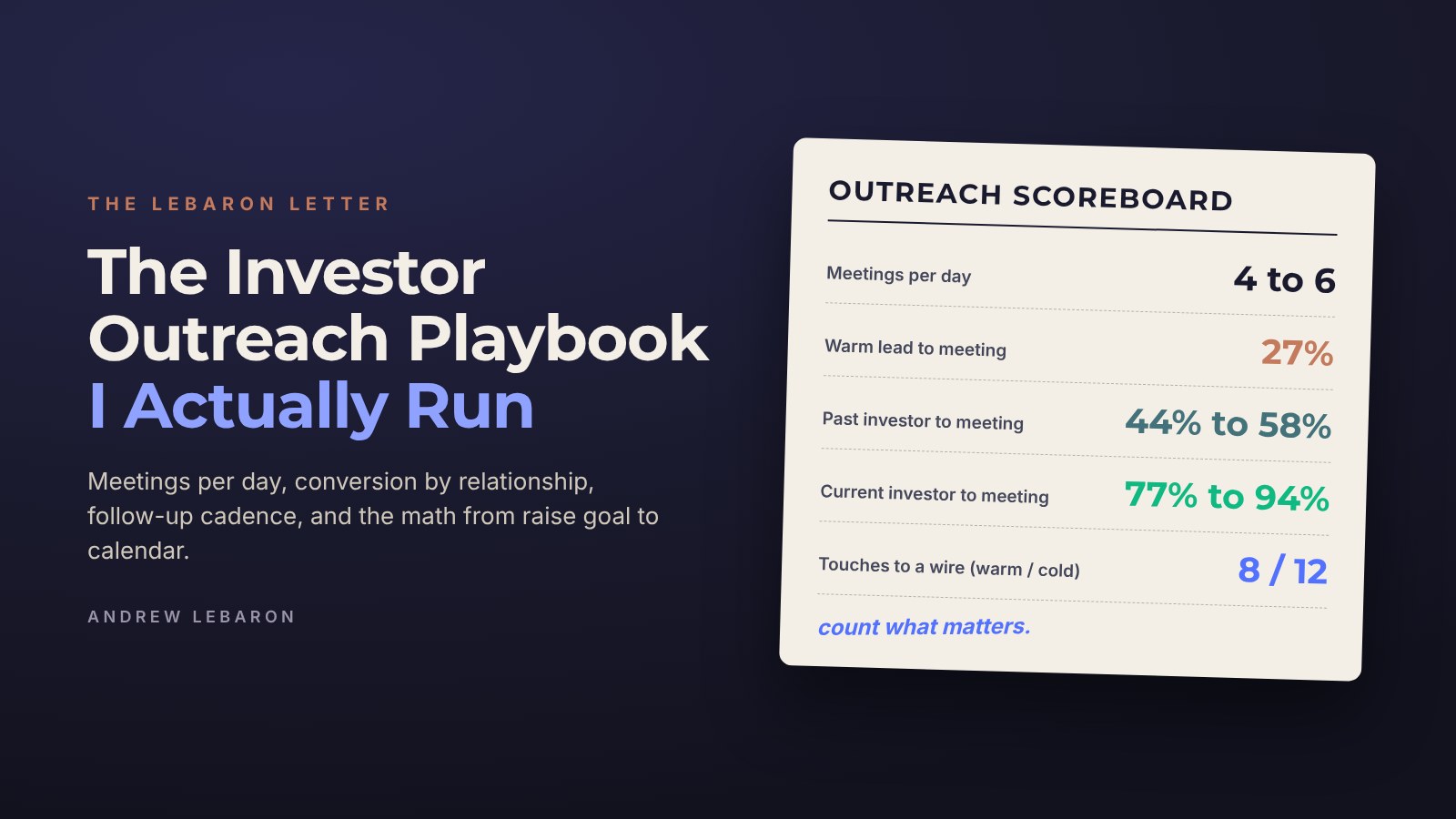
Investor outreach isn't a campaign and it isn't a sequence. It's an operation with a scoreboard. The numbers that matter are personal emails, meetings booked per day and per week, and in-person meetings. A strong investor relations associate runs 4 to 6 meetings a day, four days a week, plus one in-person day with 3 to 4 meetings. Conversion from outreach to a meeting depends almost entirely on the relationship: about 27% for warm leads, 44% to 58% for past investors, and 77% to 94% for investors with capital in a current deal. Reach out in that order, expect about 8 touches from a warm intro and 12 from cold before a wire shows up, and match everything to your securities exemption.
I. Outreach Is a Scoreboard, Not a Sequence
Most outreach advice gives you the content of the touches. What to send, in what order, with what subject line.
That's useful. It's also the easy part.
The hard part is consistency. Did you actually send the personal emails? Did you book the meetings? Did Tuesday's meeting turn into a second meeting, or did it quietly die?
You only know if you're keeping score.
I split every outreach number into two buckets.
Activity metrics are what you control: personal emails sent, meetings booked per day and per week, meetings held, in-person meetings per week, follow-ups completed.
Conversion metrics are what the market tells you: outreach to meeting, meeting to commitment, commitment to funded.
When the raise stalls, these two buckets tell you different things. Low activity means you're not working. Low conversion means it's not working: the list, the pitch, the terms, or the deal. You fix those two problems in completely different ways, and you can't tell them apart without the numbers.
If you can't tell me how many personal emails you sent and how many meetings you booked last week, you don't have a raise plan. You have a hope.
— Andrew LeBaron
II. Why I Don't Live by Dials
Every sales playbook starts with dials. Make a hundred calls, get ten conversations, book three meetings.
That math works when you're selling to consumers. It falls apart when you're raising capital from sophisticated investors.
These are people with advisors, attorneys, and full calendars. They don't respond to volume. They respond to relevance, timing, and trust. Hammering the phone doesn't build any of those.
So I track dials. You can set a goal for them. I just don't run the business on them.
What I do run it on is personal emails (written to one person, not a mass send) and meetings booked, per day and per week. Those two numbers tell me almost everything about whether a raise is healthy.
And when I measure conversion, I don't care what channel started it. Initial outreach can be an email, a LinkedIn message, a text, or a call. What matters is whether it turned into a meeting.
III. Why I Cold Email (And How)
A lot of sophisticated groups won't touch cold email. I understand why. I know how it can look.
I have a different view.
A cold call interrupts someone. A cold email waits for them. And with AI now triaging most inboxes, an unwanted email costs the recipient almost nothing. It gets sorted, skimmed, or ignored in seconds. So I don't think it's wrong to email family offices, investors, and groups who've never heard of me...
...as long as the email is worth opening.
I send about 600 cold emails a day. The process is simple:
It's extremely short. A few lines. No deck, no deal, no ask for money.
It gives something away. A report or a tool that helps the person reading it. No strings attached.
It offers a next step, not a pitch. If what I sent is useful, they can book a call, and we figure out together whether my services are a fit.
I always deliver what I said I'd deliver. Every time. That's the whole reputation of the funnel.
That's why this doesn't contradict what I said about dials. Volume dialing asks a busy person for their attention on your schedule. A short, useful email lets them decide on theirs.
Two guardrails if you do this. First, follow CAN-SPAM: accurate sender info, an honest subject line, your physical postal address, a clear way to opt out, and opt-outs honored within 10 business days. The FTC can fine more than $50,000 per violating email. Second, if you're raising under Rule 506(b), your cold emails can't be marketing an offering. Mine offer reports, tools, and a conversation about advisory services. More on that in section X.
IV. The Daily and Weekly Targets
Here's what a high-performing investor relations associate's week looks like.
Four days a week: 4 to 6 meetings a day. Mostly video and phone. That's 16 to 24 meetings across those four days.
One day a week: in person only. That day is strictly reserved for local investors: breakfast, brunch, lunch, or dinner. A strong associate hosts 3 to 4 meetings that day.
Add it up and that's 19 to 28 investor meetings a week. Per associate.
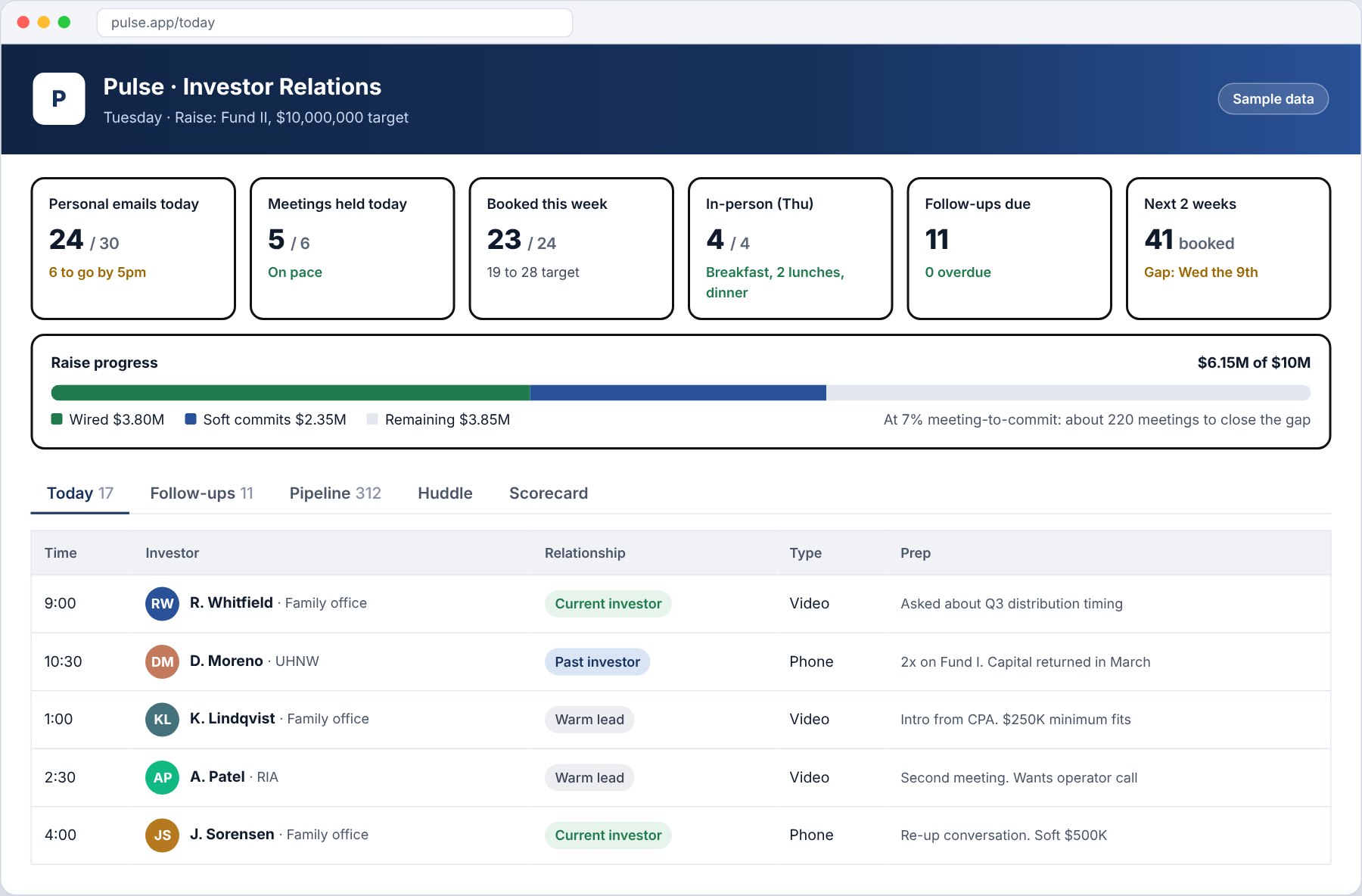
To hold that many, you have to book at least that many, every week, without gaps. That's why meetings booked per day and per week are the KPIs I watch closest. A calendar that's full this week and empty in two weeks is a pipeline problem you can see coming, if you're looking.
Personal emails are the other half. For warm follow-up with my existing investors, I aim for 20 to 30 a day. These aren't templates with a first name swapped in. They're hyper-personalized, built with AI and variable data drawn from what I actually know about each person: what they've invested in, what they asked about last time, what's going on in their world. The right number depends on the size of your investor base, but 20 to 30 a day is where I'd start.
That's separate from cold outreach. Cold email is how new people find me. Personal email is how existing investors stay close.
V. Conversion Depends on Who You're Talking To
This is the part most playbooks miss completely. They give you one conversion rate. There isn't one.
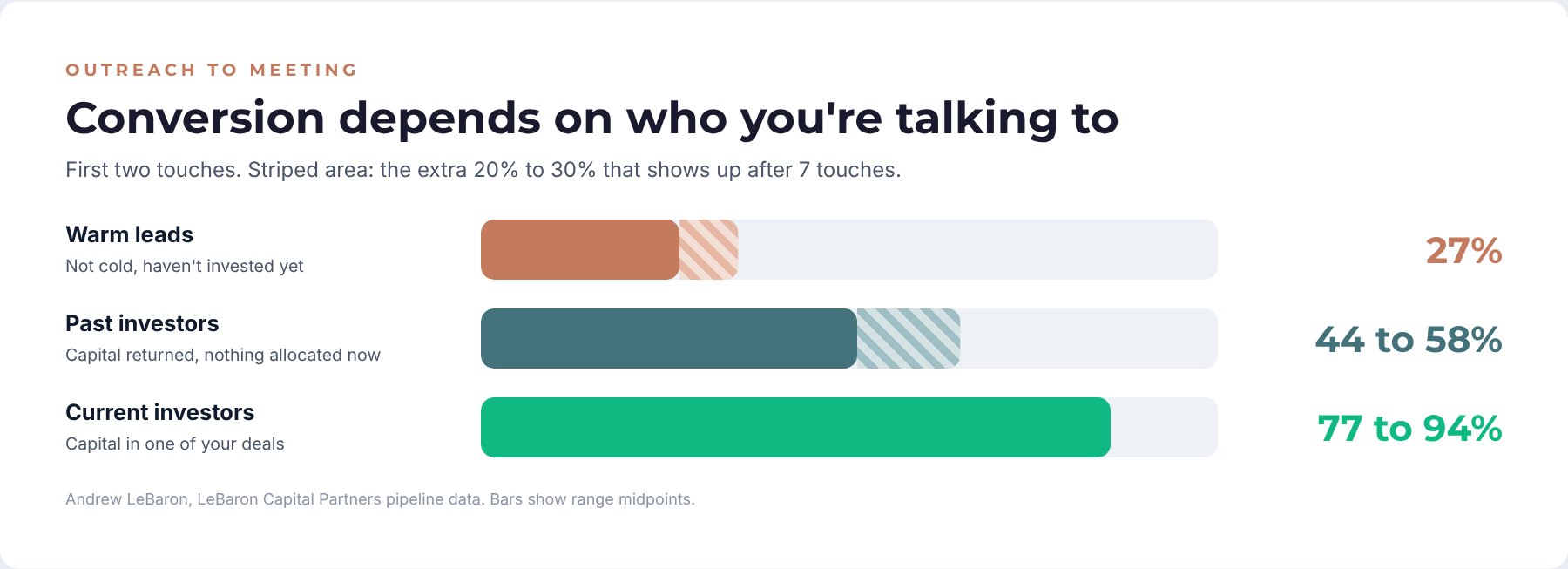
Conversion from initial outreach to a meeting depends almost entirely on the relationship. Here's what I see, based on the first two touches:
Warm leads who haven't invested with you yet: about 27%. These aren't cold. They know who you are. But they haven't written a check. Roughly one in four takes the meeting.
Past investors with nothing currently allocated: 44% to 58%. They've been through a full cycle with you. They got their capital back. Right now they don't have money in one of your deals. It's a quarter flip.
Current investors with capital actively allocated in your deal: 77% to 94%. They have skin in the game. These are the easiest meetings you'll ever book.
Read those three numbers again. Then look at how most sponsors spend their week. Chasing the 27% group while the 77% to 94% group hasn't heard from them since the last quarterly report.
Your existing investors are your highest-converting outreach list, by a wide margin. Treat them like it.
Your current investors book a meeting 77% to 94% of the time. Your warm leads, about 27%. If you're spending most of your week on the 27% group, you've got the order backwards.
— Andrew LeBaron
VI. Start With the Raise and Work Backwards
Once you know your conversion by relationship, you can build the raise from the goal down to a weekly number.
Start with check size, because it drives everything downstream.
My floor is $100,000. With family offices and ultra high net worth investors, I prefer a $250,000 minimum. With larger groups, I'm targeting $5 million to $10 million checks. Investors who've been in real estate for years understand the asset, and a lot of them see it as steadier ground than venture or crypto. That makes bigger checks a reasonable ask.
Bigger checks come with tradeoffs, though. The large groups take longer to accept terms, and they usually take a bite out of the GP's economics. Terms are always variable. They change based on who's investing and how much.
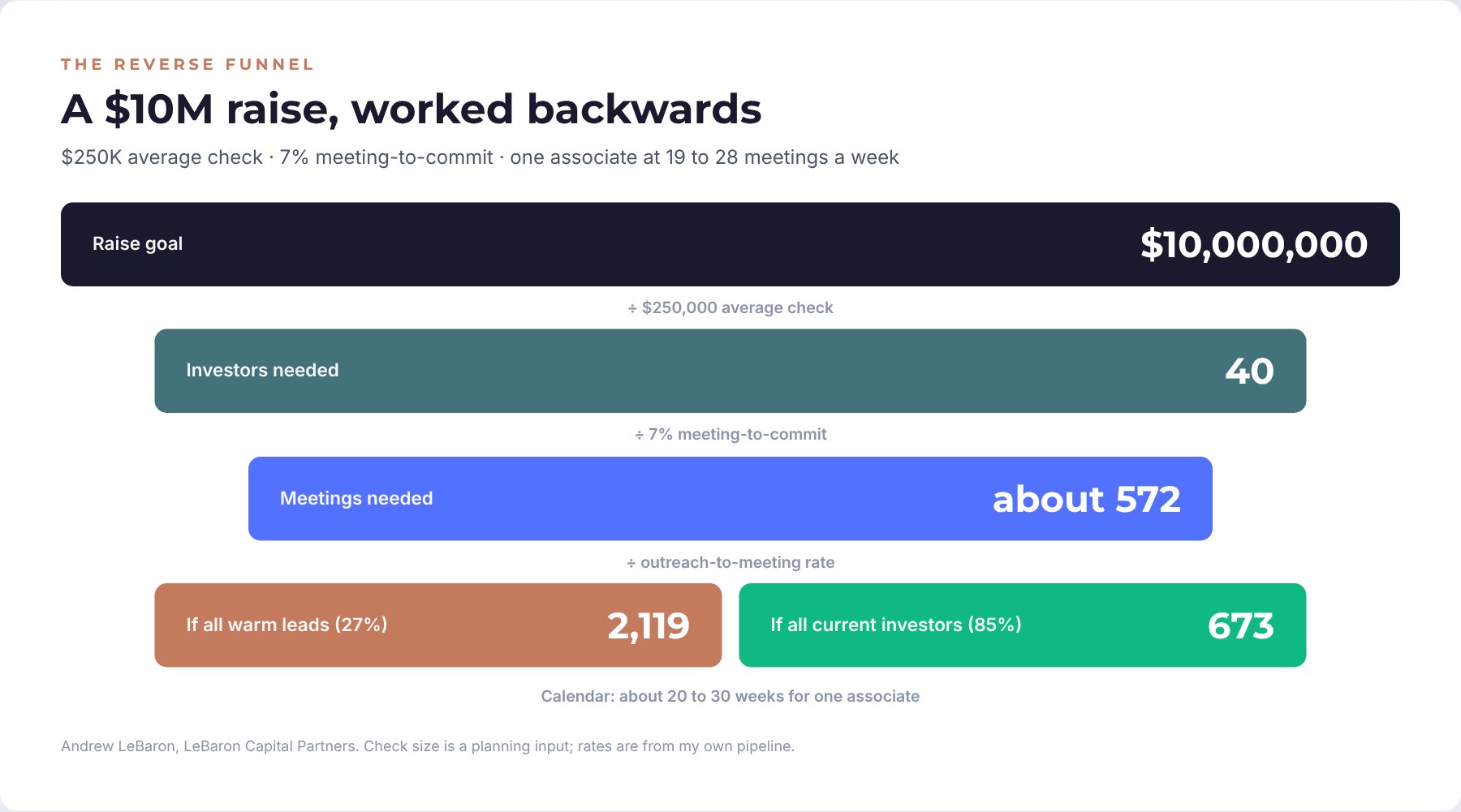
Here's the math on a raise using my preferred minimum and my real meeting-to-commit rate.
Raise goal: $10,000,000.
Average check: $250,000. That's 40 investors.
Meeting-to-commit rate: 7%. That's mine, cold and warm combined. Out of every 100 meetings I take, about 7 of those people invest. So 40 / 0.07 = about 572 meetings.
Now the relationship math kicks in. If all 572 meetings had to come from warm leads at 27%, you'd need about 2,119 initial outreaches (572 / 0.27). If they came from current investors at, say, 85%, you'd need about 673 (572 / 0.85).
Same raise. Less than a third of the outreach.
And on the calendar side, 572 meetings at 19 to 28 a week is about 20 to 30 weeks of one associate's full calendar.
Now add one large group. Land a $5 million check and the other $5 million at $250,000 is 20 investors, or about 286 meetings (20 / 0.07). That's roughly 10 to 15 weeks of calendar instead of 20 to 30. The catch: that one $5 million check can take longer to close than everything else combined, and it'll cost you some GP economics.
That's the whole plan in four lines. Raise goal, investors needed, meetings needed, outreach needed by segment. Everything else is execution.
I'll be honest about that 7%...
...it needs to be higher.
My meetings skew toward ultra high net worth investors and family offices, and those are slow, selective decisions. That's part of it. But it's still the number I'm working hardest to move, because it's the biggest lever in the whole model. Get it from 7% to 10% and the same raise drops from about 572 meetings to 400. That's roughly 6 to 9 fewer weeks on one associate's calendar.
VII. Follow-Up Is Where the Money Actually Is
Every conversion number above is based on the first two touches.
It gets better from there.
After 7 touches, those odds improve by another 20% to 30%. A 27% warm-lead rate becomes roughly 32% to 35%. A 50% past-investor rate becomes roughly 60% to 65%. That's especially true with past investors who were happy with how their investment went, start to finish.
Now look at what it takes to get all the way to the money. Not a meeting. A committed wire.
From a warm intro: about 8 touches, usually over 3 to 6 months.
From cold outreach: about 12 touches, usually over 6 to 12 months.
Most sponsors quit after two or three...
...which means most sponsors quit before the math even has a chance to work.
Those averages move based on what you bring to the table. The cycle gets shorter when you have:
A strong anchor operator or co-GP partner. Investors are underwriting the team as much as the deal.
A strong anchor investor who has already committed a large share of the equity you're raising.
A substantial track record. And the obvious ones: you've never lost investor capital, you've returned a lot of capital to investors, your average equity multiple is 2x or higher, or your average IRR is 20% or higher.
If you have none of those yet, plan for the long end of the range. If you have several, you'll feel the difference.
That gap between two touches and eight is where most capital gets left on the table. Investors go quiet for reasons that have nothing to do with you. A liquidity event hasn't closed. They're waiting on a distribution. They're traveling. Their spouse wants to look at it. Silence is almost always timing, not rejection.
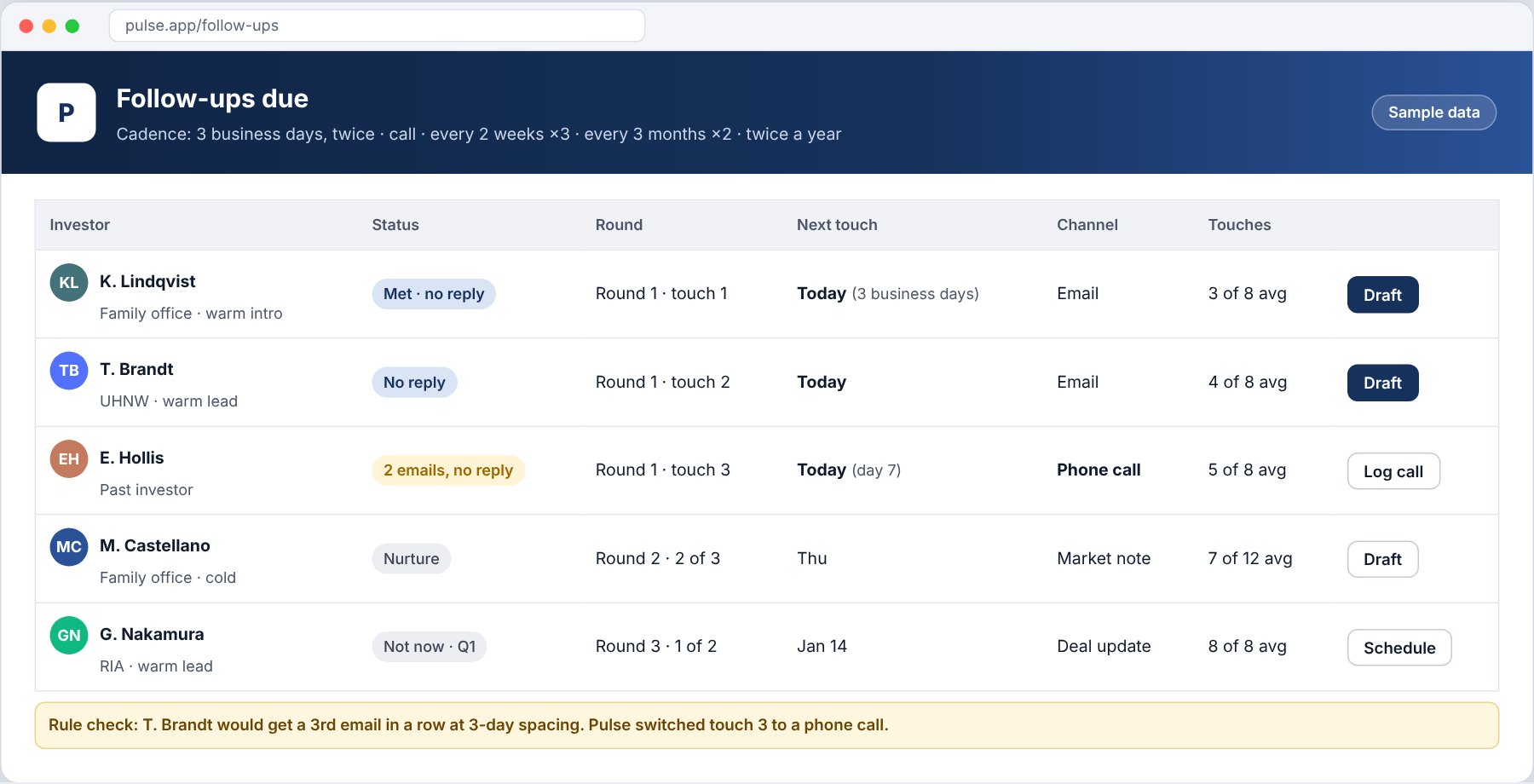
So I run follow-up on rules, not feelings:
Every meeting ends with a next step on the calendar. Not "I'll send something over." A date.
Every open loop gets touched within 3 business days. If it's not on the calendar, it doesn't exist.
Every touch adds something. A deal update, a market read, an answer to the question they asked last time. Never "just checking in."
Nobody leaves the pipeline without a reason. "Not accredited," "wrong check size," "doesn't do this asset class," and "not now" are different reasons. "Not now" goes into nurture with a date to revisit. It doesn't get deleted.
The Follow-Up Cadence
Persistence is not the same as pestering. Two rules I don't break: never follow up daily, and never follow up every 3 days more than twice in a row.
Here's the exact cadence when someone goes quiet:
Round one: three attempts in about a week. Email at 3 business days. Email again 3 business days later. Then, around day 6 or 7 depending on where the weekend falls, pick up the phone. Email first, then a call.
Round two: every two weeks, three attempts. Wait a couple of weeks, then reach out once every 2 weeks, three times.
Round three: every three months, twice.
After that: twice a year. And leave it at that.
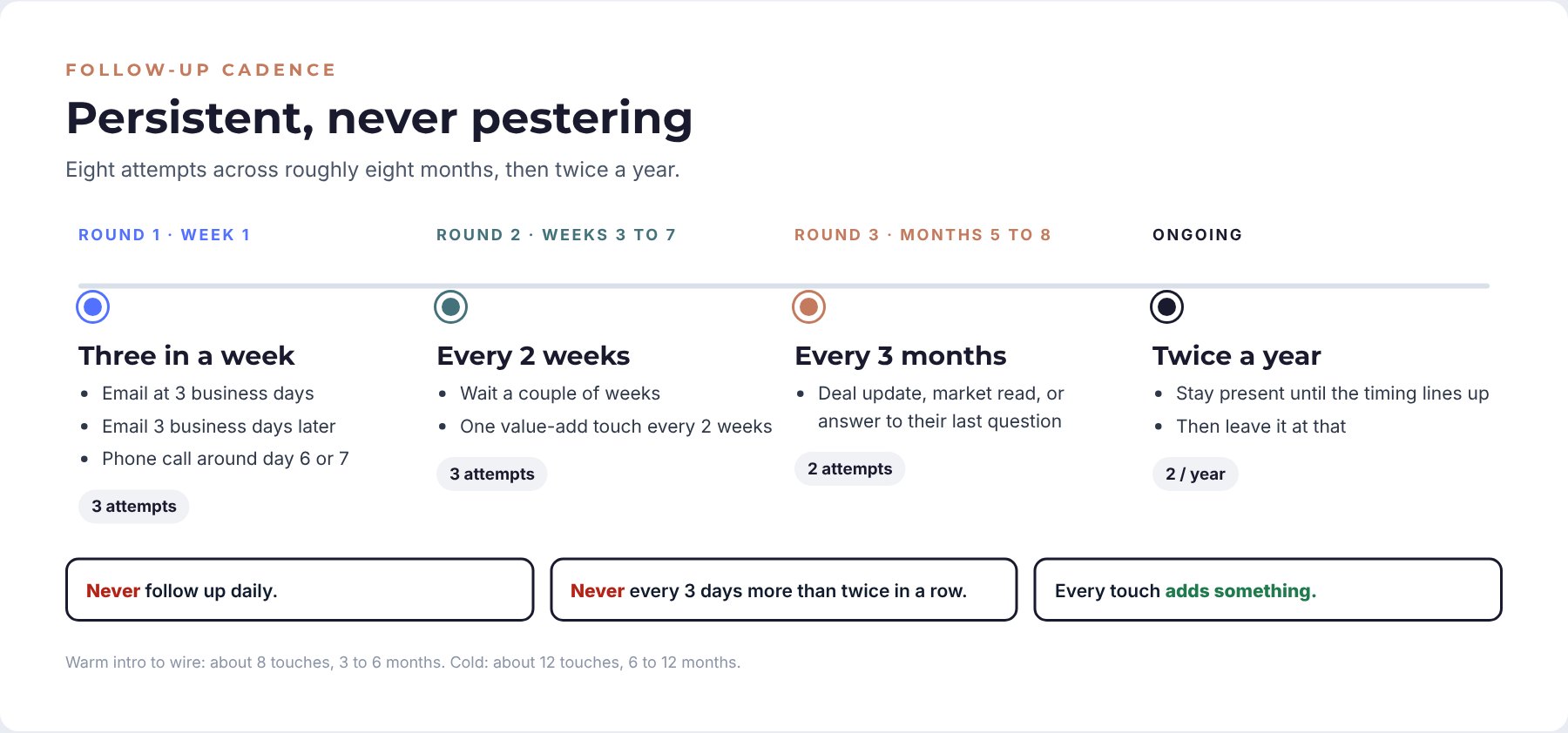
That's eight attempts before someone moves to a twice-a-year rhythm, spread across the better part of a year. It's enough that they never forget you, and spaced enough that they never resent you. When their timing finally lines up, you're the one who's still there.
VIII. The In-Person Day
One day a week, nobody on my team is on video.
That day is for investors who live close enough to sit across a table. Breakfast, brunch, lunch, dinner. Three or four of them.
Video is efficient, and we run plenty of it the other four days. But an hour in person does something a Zoom window can't. People tell you what they're actually worried about. You meet the person, not the portfolio. And the next time you reach out, you're not a name in their inbox. You're the person they had lunch with.
That's exactly the relationship that moves someone from the 27% group into the 77% to 94% group over time.
It's the cheapest relationship-building you'll ever do. Put it on the calendar every week and protect it.
IX. The Huddle: Keep the Raise Honest
If more than one person touches the raise, you need a huddle. My rules for it are strict:
Fifteen minutes. Only. It's not a meeting. It's a checkpoint.
Every day. Not when things are slow. Not when someone remembers. Every day.
In person. Not on a screen. In the same room.
Same time, no matter what. The consistency is the point.
Same three questions every time:
What were yesterday's numbers against target? Personal emails sent, meetings booked, meetings held. Just the numbers, no stories.
What does the calendar look like for the next two weeks? Gaps get filled now, not when they show up.
Who's stuck? Any investor who's had a meeting and hasn't moved gets talked about.
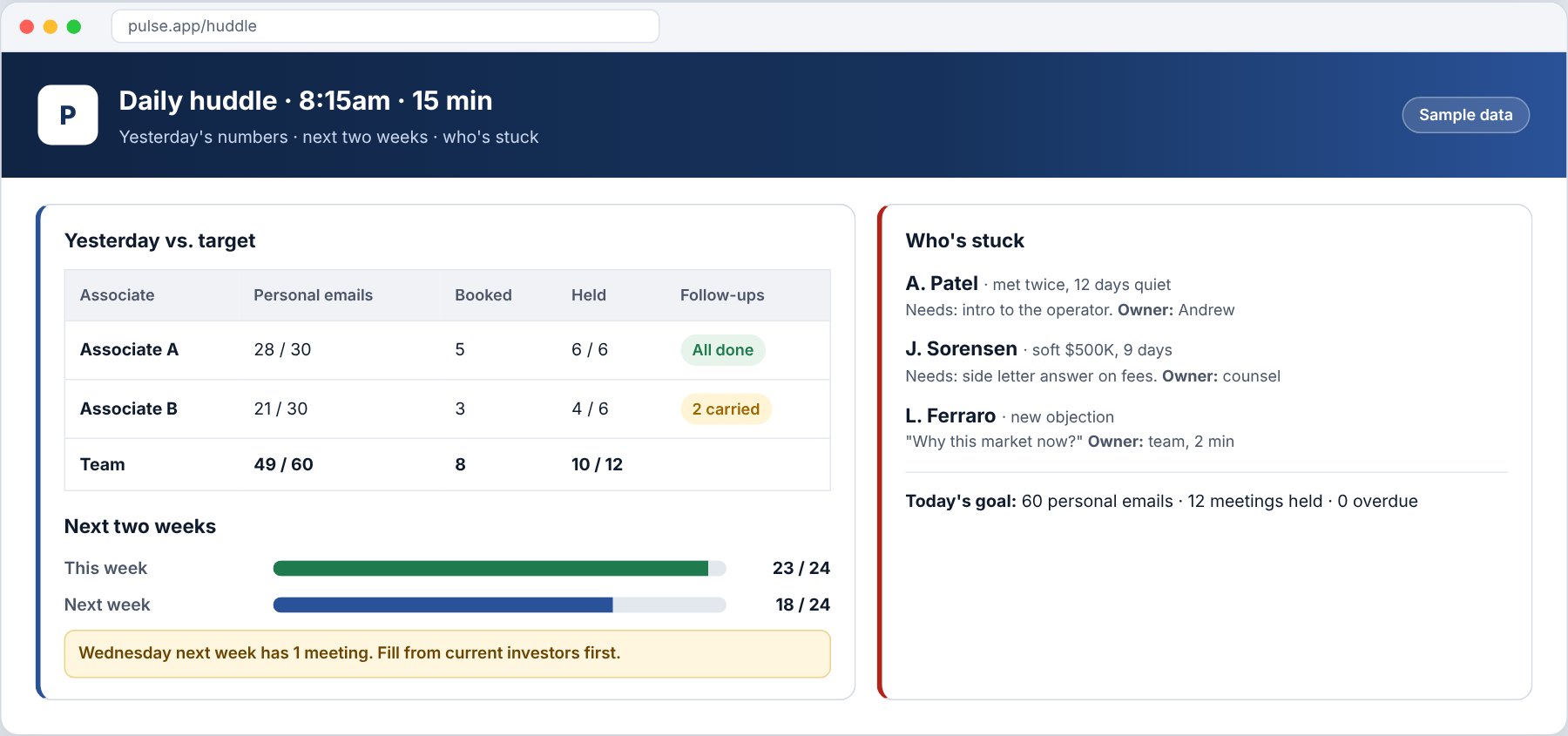
That last question is where the huddle earns its fifteen minutes. Most of the barriers in a raise are ones a single person can't solve alone. An objection you haven't heard before. An investor who needs an intro to the operator. A term that needs someone else's sign-off. Put it in front of the team and it usually gets solved in two minutes.
The rest of the value is quieter. A daily huddle builds morale. It keeps the goal in front of everyone. And activity that gets reported out loud every morning gets done.
X. Compliance Before You Reach Out
This is the part most outreach playbooks skip, and it's the part that can blow up a raise.
Under SEC Rule 506(b), there's no general solicitation or advertising allowed. If you're raising under 506(b), your outreach should be to people you have a real, pre-existing relationship with, and you need to be careful about who you're contacting cold and what you're saying.
Under Rule 506(c), you can broadly solicit and advertise, but every purchaser has to be accredited and you have to take reasonable steps to verify it.
This is exactly why my cold emails never pitch a deal. They give away a report or a tool and offer a conversation about advisory services. If you're a sponsor raising under 506(b), the same line applies to you: cold outreach can build a relationship, but it can't be how you market the offering.
So before you build an outreach engine, know which exemption you're under. It changes who you can contact, what you can post, and what your follow-up can say. Talk to your securities attorney. I'm not one, and this isn't legal advice.
XI. The Read I Keep Coming Back To
The sponsors who raise consistently aren't more charming than everyone else. They don't have a secret list.
They have a full calendar...
...and they know exactly who's on it.
They know their conversion by relationship. They talk to their current investors first. They book 4 to 6 meetings a day and protect the in-person day. They huddle on the numbers. And they follow up longer than anyone else is willing to.
None of it is complicated. It's just work, counted honestly.
Want all of this in one place? I put the full framework, the worked math, the follow-up cadence, and a weekly scorecard template into a white paper. Download The Investor Outreach Operating System (PDF).
If you're planning a raise and want to build your own scoreboard and weekly targets, I keep time open for conversations like that. No pitch. Just the numbers. Book a meeting with me here.
Nobody raises capital by accident. They raise it by doing the boring math, filling the calendar, and following up longer than anyone else is willing to.
— Andrew LeBaron
The Email Sequence That Raised Nothing
A sponsor showed me his outreach plan last month.
It was beautiful. Seven touches. Personalized first lines. A research piece at touch two, an event invite at touch three, a polite breakup email at touch seven.
I asked him one question. How many meetings did you book last week?
He didn't know...
...and that's the whole problem.
He had a sequence. He didn't have a scoreboard. And after four months, he had a clean CRM, a lot of opens, and almost no money committed.
I've seen this over and over in over a decade of raising and advising on capital. The plan isn't the problem. The plan is fine. The problem is nobody's counting the things that actually matter.
TL;DR
Investor outreach isn't a campaign and it isn't a sequence. It's an operation with a scoreboard. The numbers that matter are personal emails, meetings booked per day and per week, and in-person meetings. A strong investor relations associate runs 4 to 6 meetings a day, four days a week, plus one in-person day with 3 to 4 meetings. Conversion from outreach to a meeting depends almost entirely on the relationship: about 27% for warm leads, 44% to 58% for past investors, and 77% to 94% for investors with capital in a current deal. Reach out in that order, expect about 8 touches from a warm intro and 12 from cold before a wire shows up, and match everything to your securities exemption.
I. Outreach Is a Scoreboard, Not a Sequence
Most outreach advice gives you the content of the touches. What to send, in what order, with what subject line.
That's useful. It's also the easy part.
The hard part is consistency. Did you actually send the personal emails? Did you book the meetings? Did Tuesday's meeting turn into a second meeting, or did it quietly die?
You only know if you're keeping score.
I split every outreach number into two buckets.
Activity metrics are what you control: personal emails sent, meetings booked per day and per week, meetings held, in-person meetings per week, follow-ups completed.
Conversion metrics are what the market tells you: outreach to meeting, meeting to commitment, commitment to funded.
When the raise stalls, these two buckets tell you different things. Low activity means you're not working. Low conversion means it's not working: the list, the pitch, the terms, or the deal. You fix those two problems in completely different ways, and you can't tell them apart without the numbers.
If you can't tell me how many personal emails you sent and how many meetings you booked last week, you don't have a raise plan. You have a hope.
— Andrew LeBaron
II. Why I Don't Live by Dials
Every sales playbook starts with dials. Make a hundred calls, get ten conversations, book three meetings.
That math works when you're selling to consumers. It falls apart when you're raising capital from sophisticated investors.
These are people with advisors, attorneys, and full calendars. They don't respond to volume. They respond to relevance, timing, and trust. Hammering the phone doesn't build any of those.
So I track dials. You can set a goal for them. I just don't run the business on them.
What I do run it on is personal emails (written to one person, not a mass send) and meetings booked, per day and per week. Those two numbers tell me almost everything about whether a raise is healthy.
And when I measure conversion, I don't care what channel started it. Initial outreach can be an email, a LinkedIn message, a text, or a call. What matters is whether it turned into a meeting.
III. Why I Cold Email (And How)
A lot of sophisticated groups won't touch cold email. I understand why. I know how it can look.
I have a different view.
A cold call interrupts someone. A cold email waits for them. And with AI now triaging most inboxes, an unwanted email costs the recipient almost nothing. It gets sorted, skimmed, or ignored in seconds. So I don't think it's wrong to email family offices, investors, and groups who've never heard of me...
...as long as the email is worth opening.
I send about 600 cold emails a day. The process is simple:
It's extremely short. A few lines. No deck, no deal, no ask for money.
It gives something away. A report or a tool that helps the person reading it. No strings attached.
It offers a next step, not a pitch. If what I sent is useful, they can book a call, and we figure out together whether my services are a fit.
I always deliver what I said I'd deliver. Every time. That's the whole reputation of the funnel.
That's why this doesn't contradict what I said about dials. Volume dialing asks a busy person for their attention on your schedule. A short, useful email lets them decide on theirs.
Two guardrails if you do this. First, follow CAN-SPAM: accurate sender info, an honest subject line, your physical postal address, a clear way to opt out, and opt-outs honored within 10 business days. The FTC can fine more than $50,000 per violating email. Second, if you're raising under Rule 506(b), your cold emails can't be marketing an offering. Mine offer reports, tools, and a conversation about advisory services. More on that in section X.
IV. The Daily and Weekly Targets
Here's what a high-performing investor relations associate's week looks like.
Four days a week: 4 to 6 meetings a day. Mostly video and phone. That's 16 to 24 meetings across those four days.
One day a week: in person only. That day is strictly reserved for local investors: breakfast, brunch, lunch, or dinner. A strong associate hosts 3 to 4 meetings that day.
Add it up and that's 19 to 28 investor meetings a week. Per associate.
To hold that many, you have to book at least that many, every week, without gaps. That's why meetings booked per day and per week are the KPIs I watch closest. A calendar that's full this week and empty in two weeks is a pipeline problem you can see coming, if you're looking.
Personal emails are the other half. For warm follow-up with my existing investors, I aim for 20 to 30 a day. These aren't templates with a first name swapped in. They're hyper-personalized, built with AI and variable data drawn from what I actually know about each person: what they've invested in, what they asked about last time, what's going on in their world. The right number depends on the size of your investor base, but 20 to 30 a day is where I'd start.
That's separate from cold outreach. Cold email is how new people find me. Personal email is how existing investors stay close.
V. Conversion Depends on Who You're Talking To
This is the part most playbooks miss completely. They give you one conversion rate. There isn't one.
Conversion from initial outreach to a meeting depends almost entirely on the relationship. Here's what I see, based on the first two touches:
Warm leads who haven't invested with you yet: about 27%. These aren't cold. They know who you are. But they haven't written a check. Roughly one in four takes the meeting.
Past investors with nothing currently allocated: 44% to 58%. They've been through a full cycle with you. They got their capital back. Right now they don't have money in one of your deals. It's a quarter flip.
Current investors with capital actively allocated in your deal: 77% to 94%. They have skin in the game. These are the easiest meetings you'll ever book.
Read those three numbers again. Then look at how most sponsors spend their week. Chasing the 27% group while the 77% to 94% group hasn't heard from them since the last quarterly report.
Your existing investors are your highest-converting outreach list, by a wide margin. Treat them like it.
Your current investors book a meeting 77% to 94% of the time. Your warm leads, about 27%. If you're spending most of your week on the 27% group, you've got the order backwards.
— Andrew LeBaron
VI. Start With the Raise and Work Backwards
Once you know your conversion by relationship, you can build the raise from the goal down to a weekly number.
Start with check size, because it drives everything downstream.
My floor is $100,000. With family offices and ultra high net worth investors, I prefer a $250,000 minimum. With larger groups, I'm targeting $5 million to $10 million checks. Investors who've been in real estate for years understand the asset, and a lot of them see it as steadier ground than venture or crypto. That makes bigger checks a reasonable ask.
Bigger checks come with tradeoffs, though. The large groups take longer to accept terms, and they usually take a bite out of the GP's economics. Terms are always variable. They change based on who's investing and how much.
Here's the math on a raise using my preferred minimum and my real meeting-to-commit rate.
Raise goal: $10,000,000.
Average check: $250,000. That's 40 investors.
Meeting-to-commit rate: 7%. That's mine, cold and warm combined. Out of every 100 meetings I take, about 7 of those people invest. So 40 / 0.07 = about 572 meetings.
Now the relationship math kicks in. If all 572 meetings had to come from warm leads at 27%, you'd need about 2,119 initial outreaches (572 / 0.27). If they came from current investors at, say, 85%, you'd need about 673 (572 / 0.85).
Same raise. Less than a third of the outreach.
And on the calendar side, 572 meetings at 19 to 28 a week is about 20 to 30 weeks of one associate's full calendar.
Now add one large group. Land a $5 million check and the other $5 million at $250,000 is 20 investors, or about 286 meetings (20 / 0.07). That's roughly 10 to 15 weeks of calendar instead of 20 to 30. The catch: that one $5 million check can take longer to close than everything else combined, and it'll cost you some GP economics.
That's the whole plan in four lines. Raise goal, investors needed, meetings needed, outreach needed by segment. Everything else is execution.
I'll be honest about that 7%...
...it needs to be higher.
My meetings skew toward ultra high net worth investors and family offices, and those are slow, selective decisions. That's part of it. But it's still the number I'm working hardest to move, because it's the biggest lever in the whole model. Get it from 7% to 10% and the same raise drops from about 572 meetings to 400. That's roughly 6 to 9 fewer weeks on one associate's calendar.
VII. Follow-Up Is Where the Money Actually Is
Every conversion number above is based on the first two touches.
It gets better from there.
After 7 touches, those odds improve by another 20% to 30%. A 27% warm-lead rate becomes roughly 32% to 35%. A 50% past-investor rate becomes roughly 60% to 65%. That's especially true with past investors who were happy with how their investment went, start to finish.
Now look at what it takes to get all the way to the money. Not a meeting. A committed wire.
From a warm intro: about 8 touches, usually over 3 to 6 months.
From cold outreach: about 12 touches, usually over 6 to 12 months.
Most sponsors quit after two or three...
...which means most sponsors quit before the math even has a chance to work.
Those averages move based on what you bring to the table. The cycle gets shorter when you have:
A strong anchor operator or co-GP partner. Investors are underwriting the team as much as the deal.
A strong anchor investor who has already committed a large share of the equity you're raising.
A substantial track record. And the obvious ones: you've never lost investor capital, you've returned a lot of capital to investors, your average equity multiple is 2x or higher, or your average IRR is 20% or higher.
If you have none of those yet, plan for the long end of the range. If you have several, you'll feel the difference.
That gap between two touches and eight is where most capital gets left on the table. Investors go quiet for reasons that have nothing to do with you. A liquidity event hasn't closed. They're waiting on a distribution. They're traveling. Their spouse wants to look at it. Silence is almost always timing, not rejection.
So I run follow-up on rules, not feelings:
Every meeting ends with a next step on the calendar. Not "I'll send something over." A date.
Every open loop gets touched within 3 business days. If it's not on the calendar, it doesn't exist.
Every touch adds something. A deal update, a market read, an answer to the question they asked last time. Never "just checking in."
Nobody leaves the pipeline without a reason. "Not accredited," "wrong check size," "doesn't do this asset class," and "not now" are different reasons. "Not now" goes into nurture with a date to revisit. It doesn't get deleted.
The Follow-Up Cadence
Persistence is not the same as pestering. Two rules I don't break: never follow up daily, and never follow up every 3 days more than twice in a row.
Here's the exact cadence when someone goes quiet:
Round one: three attempts in about a week. Email at 3 business days. Email again 3 business days later. Then, around day 6 or 7 depending on where the weekend falls, pick up the phone. Email first, then a call.
Round two: every two weeks, three attempts. Wait a couple of weeks, then reach out once every 2 weeks, three times.
Round three: every three months, twice.
After that: twice a year. And leave it at that.
That's eight attempts before someone moves to a twice-a-year rhythm, spread across the better part of a year. It's enough that they never forget you, and spaced enough that they never resent you. When their timing finally lines up, you're the one who's still there.
VIII. The In-Person Day
One day a week, nobody on my team is on video.
That day is for investors who live close enough to sit across a table. Breakfast, brunch, lunch, dinner. Three or four of them.
Video is efficient, and we run plenty of it the other four days. But an hour in person does something a Zoom window can't. People tell you what they're actually worried about. You meet the person, not the portfolio. And the next time you reach out, you're not a name in their inbox. You're the person they had lunch with.
That's exactly the relationship that moves someone from the 27% group into the 77% to 94% group over time.
It's the cheapest relationship-building you'll ever do. Put it on the calendar every week and protect it.
IX. The Huddle: Keep the Raise Honest
If more than one person touches the raise, you need a huddle. My rules for it are strict:
Fifteen minutes. Only. It's not a meeting. It's a checkpoint.
Every day. Not when things are slow. Not when someone remembers. Every day.
In person. Not on a screen. In the same room.
Same time, no matter what. The consistency is the point.
Same three questions every time:
What were yesterday's numbers against target? Personal emails sent, meetings booked, meetings held. Just the numbers, no stories.
What does the calendar look like for the next two weeks? Gaps get filled now, not when they show up.
Who's stuck? Any investor who's had a meeting and hasn't moved gets talked about.
That last question is where the huddle earns its fifteen minutes. Most of the barriers in a raise are ones a single person can't solve alone. An objection you haven't heard before. An investor who needs an intro to the operator. A term that needs someone else's sign-off. Put it in front of the team and it usually gets solved in two minutes.
The rest of the value is quieter. A daily huddle builds morale. It keeps the goal in front of everyone. And activity that gets reported out loud every morning gets done.
X. Compliance Before You Reach Out
This is the part most outreach playbooks skip, and it's the part that can blow up a raise.
Under SEC Rule 506(b), there's no general solicitation or advertising allowed. If you're raising under 506(b), your outreach should be to people you have a real, pre-existing relationship with, and you need to be careful about who you're contacting cold and what you're saying.
Under Rule 506(c), you can broadly solicit and advertise, but every purchaser has to be accredited and you have to take reasonable steps to verify it.
This is exactly why my cold emails never pitch a deal. They give away a report or a tool and offer a conversation about advisory services. If you're a sponsor raising under 506(b), the same line applies to you: cold outreach can build a relationship, but it can't be how you market the offering.
So before you build an outreach engine, know which exemption you're under. It changes who you can contact, what you can post, and what your follow-up can say. Talk to your securities attorney. I'm not one, and this isn't legal advice.
XI. The Read I Keep Coming Back To
The sponsors who raise consistently aren't more charming than everyone else. They don't have a secret list.
They have a full calendar...
...and they know exactly who's on it.
They know their conversion by relationship. They talk to their current investors first. They book 4 to 6 meetings a day and protect the in-person day. They huddle on the numbers. And they follow up longer than anyone else is willing to.
None of it is complicated. It's just work, counted honestly.
Want all of this in one place? I put the full framework, the worked math, the follow-up cadence, and a weekly scorecard template into a white paper. Download The Investor Outreach Operating System (PDF).
If you're planning a raise and want to build your own scoreboard and weekly targets, I keep time open for conversations like that. No pitch. Just the numbers. Book a meeting with me here.
Nobody raises capital by accident. They raise it by doing the boring math, filling the calendar, and following up longer than anyone else is willing to.
— Andrew LeBaron

Andrew LeBaron